
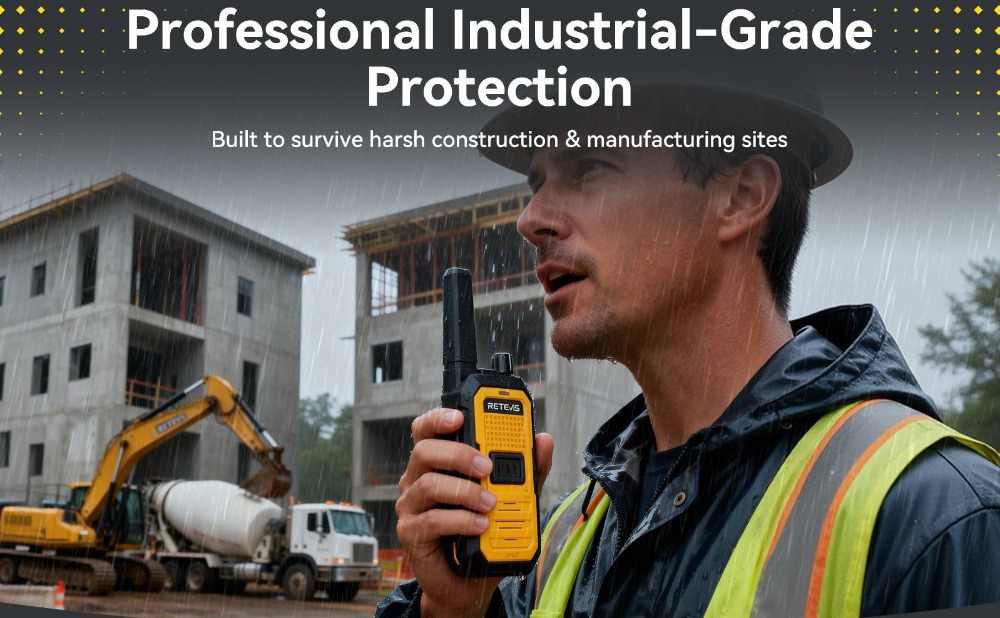
If you want a radio that survives the toughest environments, it’s all about material and structure.
The “Graveyard” of Broken Radios
If you manage a construction site or a manufacturing plant, you have likely seen the “radio graveyard.” It’s that box in the office filled with devices that didn’t make it.
Usually, they fail for one of three reasons:
The Gravity Test: Dropped from a ladder or scaffolding onto concrete.
The Dust Death: Fine concrete powder or metal shavings clogging the microphone and buttons.
The Screen Crack: A tool hits the display, shattering the glass and compromising the weather seal.
Many radios claim to be “rugged,” but there is a big difference between a radio wrapped in hard plastic and one engineered for industrial survival. Let’s break down the science of durability—and why sometimes, having fewer features actually means having more reliability.
The Material and StructureScience: Why “Hard” Isn’t Enough
A common misconception is that a durable radio needs to be rock-hard. But in physics, hardness can effectively mean brittleness. When a rigid plastic device hits the ground, the shockwave travels straight to the internal circuit board, often snapping solder joints.
The Solution: The “Sandwich” Method
The gold standard for industrial durability—which we applied to the Retevis RB48A—is utilizing a combination of materials:
- The Core (PC– Polycarbonate): This provides the rigid skeleton. Unlike standard plastic, Polycarbonate is the same material used in safety eyewear. It resists crushing pressure.
- The Armor (TPE– Thermoplastic Elastomer): This is the “soft” layer you feel on the grip. TPE acts like a shock absorber on a car.
Why it matters to you: When your RB48A accidentally slips off a belt clip and hits the floor (tested repeatedly from heights of over 1 meter), the TPE armor absorbs the kinetic energy so the electronics don’t have to.
The Case for “No Screen”: Adding Strength by Subtracting Glass
We often get asked: “Why create a radio without a screen in 2026?”
The answer lies in structural integrity. On a busy job site, the screen is the biggest vulnerability. It scratches easily in sandy environments, making it hard to read. More importantly, a screen is a “hole” in the device’s armor—a weak point where water and dust often force their way in.
The “Monocoque” Advantage
By removing the screen, as we did with the RB48A, we create a solid, unbroken front panel.
- No Scratches: You can toss it in a toolbox with wrenches and drivers without worrying about damaging a display.
- Better Sealing: Fewer cutouts mean fewer pathways for water ingress.
- Focus: It simplifies the tool. No menus to get lost in, just reliable communication.
Understanding Water & Dust Protection (Beyond the Sticker)
You’ve seen “Waterproof” on packaging before, but real industrial environments need more than just splash resistance. Construction dust is insidious; it’s finer than sand and can destroy buttons from the inside out.
This is where the IP67 Rating becomes critical.
- Dust Tight (The ‘6’):No ingress of dust; complete protection against contact.
- Immersion (The ‘7’):The device can be submerged in water (up to 1 meter depth).
The Real-World Scenario:
Imagine a radio falls into a muddy puddle or wet concrete. With a standard radio, it’s game over. With an IP67 device like the RB48A, you can literally rinse it off under a tap and keep working. The internal acoustic membranes let sound out but stop water molecules from getting in.
Designed for Hands, Not Just Fingers
Durability also means usability. In industrial settings, workers wear heavy protective gloves. A tiny button that requires a fingernail press is a frustration, not a feature.
This is why “Heavy Duty” design focuses on tactile ergonomics.
- Oversized Controls: The RB48A features a Dual PTT (Push-to-Talk)setup and large, distinct buttons.
- Long-Term Reliability: Buttons are mechanical parts that wear out. A true industrial radio tests its keys for tens of thousands of presses to ensure that the “click” feels the same on Day 1000 as it did on Day 1.
Summary: Choosing the Right Tool
When selecting a radio for your team, look past the flashy features. Ask the hard questions:
- Does it have shock-absorbing materials (PC+TPE)?
- Is the screen necessary, or is it a liability?
- Can it survive being washed off at the end of a shift (IP67)?
Retevis RB48A was built as a direct response to these questions. We took the proven performance of the RB48 series and stripped away the vulnerabilities, reinforcing the shell to create a communication tool that simply refuses to quit.
Because on the job site, the best radio isn’t the one with the most buttons—it’s the one that still works after the lunch break.
Views: 2