
Discover why a handheld marine VHF radio is essential for kayak safety—even just a mile offshore—and how it can be your invisible life-saving companion.
Scroll through any kayaking or coastal fishing forum, and you will inevitably see the exact same question posted by beginners: “I only paddle a mile out, and I have full cell service. Do I really need to buy a handheld marine VHF radio even if I stay close to shore?”
It is a logical question if you apply land-based thinking to the ocean. On land, your phone is a universal lifeline. On the water, a smartphone tucked inside a plastic dry bag is a false sense of security. The wind can blow a kayak offshore in minutes, and calling 911 means trying to explain your GPS coordinates to a dispatcher sitting in an office miles away.
A marine VHF radio operates entirely differently. It is an “invisible bodyguard” that broadcasts your voice directly to the Coast Guard and every single boat in your immediate vicinity. To understand why a dedicated radio is non-negotiable—even close to the beach—we can look at the physical realities of water sports and how a device like the Retevis RM15 is specifically engineered to solve them.
The “Wet Hands” Reality: Why Touchscreens Fail
When things go wrong on the water, they go wrong fast. A sudden wave flips your kayak, or your small outboard motor dies while the tide is pulling out. You are now wet, cold, and dealing with an adrenaline spike.
Try unlocking a smartphone screen with wet fingers through a plastic pouch while treading water. It rarely works. Marine communication relies on tactile, blind operation. A purpose-built handheld marine VHF radio gives you physical buttons that work no matter what. On the RM15, the most critical feature is the dedicated 16/9 key. A quick, short press immediately tunes the device to Channel 16—the international distress frequency monitored by everyone. If you need to coordinate with a local marina, a long press (1 second) jumps directly to your preset call channel. You don’t need to look at a screen; you just press the button and speak.
The Near-Shore Micro-Climate
Weather on the coast is notoriously deceptive. A sunny beach can quickly be overshadowed by a sudden, localized squall that kicks up heavy chop. Relying on a weather app means relying on cellular data and delayed radar loops.
Marine radios bypass cell towers completely. They act as a direct line to continuous atmospheric broadcasts. The RM15 handles this with a dedicated CH/WX button. A short press cuts through standard radio traffic and connects you instantly to local weatherchannels. Because marine frequencies are highly regulated depending on your location, holding that same button for one second allows you to seamlessly switch between USA, Canadian (CNA), and International (INT) bands. You receive the warning straight from the source, giving you time to paddle back before the wind hits.
The Physics of a Dropped Radio
The biggest hesitation people have about electronics on the water is the fear of dropping them. If a phone goes into the drink without a tether, it is gone. If a cheap, waterproof walkie-talkie falls in, it might survive, but water surface tension will seal the tiny holes of the speaker grille, making the audio completely muffled and useless.
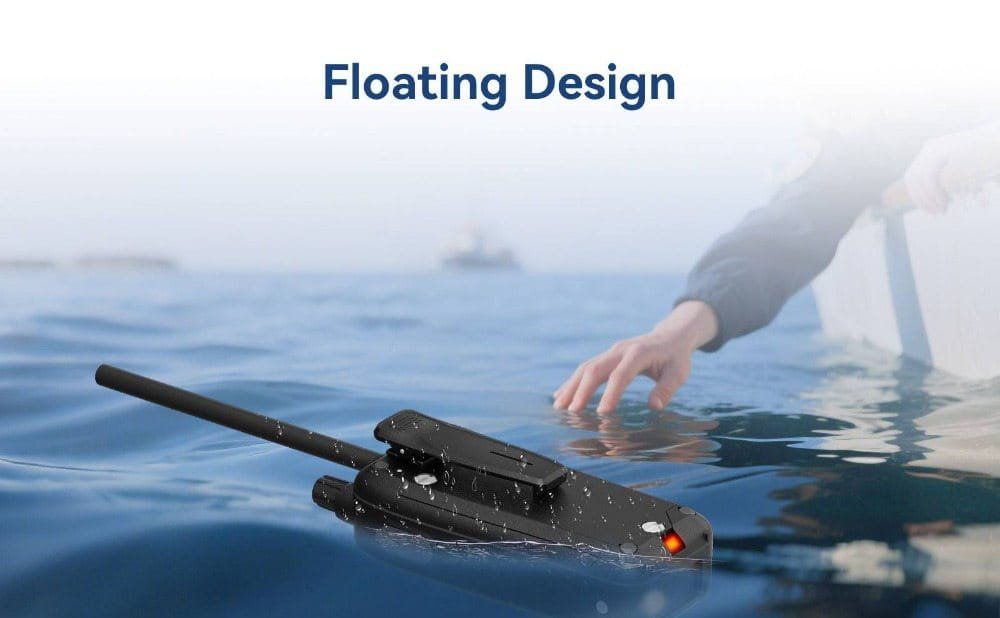
A real marine radio treats water as an expected environment, not a hazard. The RM15 is built with water immersion detection contacts on the bottom. If it slips out of your kayak, it floats, and a bright bottom alarm light turns on automatically so you can grab it. Once you have it back, you solve the muffled speaker physics by simply long-pressing the MENU key for 1 second. This triggers a vibration drainage function—the radio emits a specific low-frequency pulse that literally shakes the water droplets out of the speaker mesh, restoring clear audio instantly.
Avoiding Tunnel Vision with Tri-Watch
If you are kayak fishing with a group, you will likely save a specific frequency to chat with your friends (easily done using the RM15’s FAV key). The danger here is isolation. If you only listen to your friends, you might miss a Coast Guard warning or a distress call from a boat just around the point.
To maintain situational awareness without giving up your private chat, marine radios use a scanning protocol. By long-pressing the SCAN/DW button for 1 second on the RM15, you activate Tri-Watch mode. The radio’s receiver will now rapidly cycle between three frequencies: your current channel, the critical Channel 16, and your designated call channel. The radio actively guards your safety in the background while you focus on casting your line.
The Bottom Line
Staying close to shore does not exempt you from the laws of nature. The ocean does not care if you are one mile out or ten.
Treating a handheld marine VHF radio as optional gear is a mistake. It is a fundamental piece of safety equipment, right next to your personal flotation device. Understanding how to utilize dedicated emergency keys, access raw weather data, and clear a waterlogged speaker turns a radio like the Retevis RM15 into an active survival tool. Before you un-tie from the dock, clip your invisible bodyguard to your vest. It is the cheapest life insurance policy you will ever buy.
Views: 1