
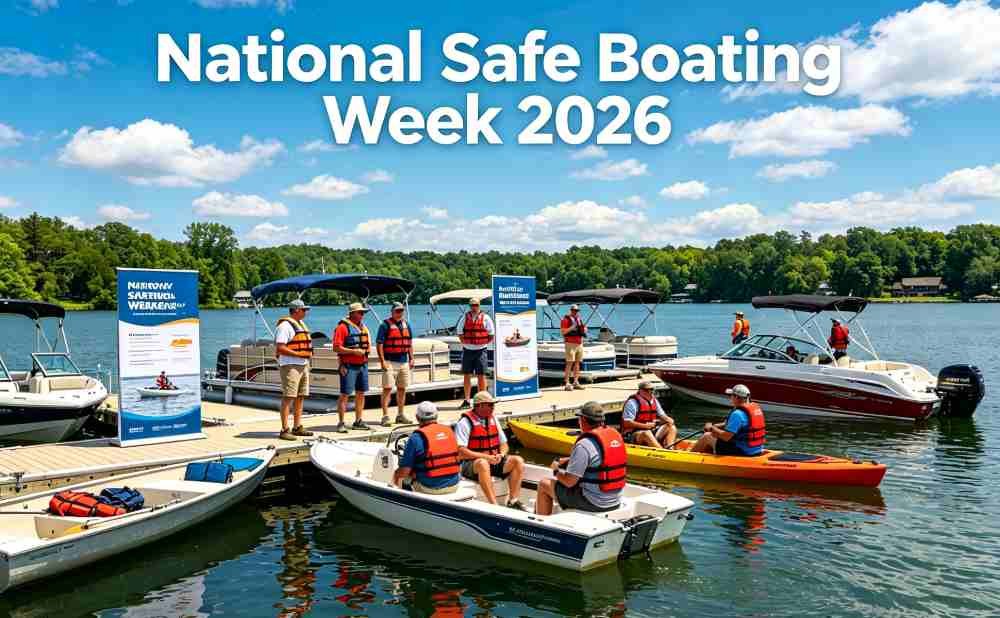
Getting ready for National Safe Boating Week? Discover why your cell phone is a terrible life preserver and how a floating handheld marine radio keeps you compliant, connected, and safe on the water.
As Memorial Day approaches, boaters across the U.S. gather at marinas and coastal spots to kick off the summer season. It also marks the start of National Safe Boating Week (NSBW)—an annual initiative led by the U.S. Coast Guard (USCG) to keep us safe on the water.
While the NSBW correctly places a massive emphasis on wearing life jackets (seriously, Wear It!), there’s a sobering statistic every boater needs to hear. According to recent USCG safety reports, a significant percentage of recreational boating emergencies involve folks who relied solely on cell phones for communication.
Nowadays, it’s incredibly common to see kayakers or small boat owners heading out with nothing but a smartphone tucked into a waterproof pouch. But when you are out on the open water, relying on a cell phone isn’t enough, and a floating handheld marine radio is the ultimate non-negotiable lifeline. Here is why.
The Smartphone Illusion: Dead Zones and Wet Screens
We love our smartphones, but cellular networks are built to point inland, not out to sea. Once you get a mile offshore—or even in certain coastal bends—cell service simply drops dead.
More importantly, imagine a real emergency. The wind is howling, and your hands are freezing and wet. Try swiping to unlock a wet smartphone screen through a damp plastic pouch while bouncing on three-foot waves. It’s nearly impossible. Furthermore, a cell phone can only call one person at a time. It cannot alert nearby vessels that you are in trouble.
The Walkie-Talkie Trap: Saltwater is Brutal
“But I have a pair of heavy-duty walkie-talkies from my last hunting trip!” This is a trap many beginners fall into. Standard FRS/GMRS two-way radios are fantastic for the woods, but they are completely out of their element on the ocean.
Saltwater is highly corrosive. The moment a wave splashes over the deck onto a regular land-based radio, the internal components start to fry. Even worse, standard radios sink like a stone. If it slips out of your hand, it belongs to the ocean floor now.
Why the USCG Pushes for Dedicated Marine Radios
During National Safe Boating Week, local marinas host hands-on workshops emphasizing one thing: direct access to help. The USCG monitors Channel 16—the international distress frequency—24/7. When you broadcast a mayday call on a marine frequency, you aren’t just calling the Coast Guard; you are broadcasting to every single boat in your vicinity. Often, the fastest rescue comes from a fellow boater who happens to be a half-mile away.
Beyond safety, there is the compliance factor. While the Federal Communications Commission (FCC) only mandates marine radios for larger vessels, the USCG strongly urges every single recreational vessel (yes, even kayaks and jet skis) to carry one.
Meeting the Standard: The Practicality of the Retevis RM15
If you are upgrading your safety kit this season, you need gear that is strictly compliant, rugged, and practical. This is exactly what makes a floating handheld marine radio like the Retevis RM15 an essential piece of deck gear for smart boaters.
We designed the RM15 to solve the exact problems mentioned above without breaking the bank:
- It Floats and Flashes:With an IPX7 waterproof rating, it easily survives being fully submerged. More importantly, if you drop it overboard, it bobs right back to the surface and activates a flashing light so you can easily retrieve it in the dark.
- Vibration Water Draining:This is a feature seasoned boaters love. If the speaker gets waterlogged from a sudden splash, the radio vibrates to shake the water out of the speaker grill, ensuring audio from the Coast Guard remains loud and clear.
- Built-in NOAA Weather Alerts:The ocean is unpredictable. The RM15 keeps you constantly looped into the National Weather Service, actively alerting you to sudden squalls so you can head back to the dock in time.
- Compact & PFD-Friendly:It’s lightweight enough to clip directly onto your life jacket. If you capsize, your radio is right there with you on your chest.
The Bottom Line
National Safe Boating Week is a great reminder that the ocean doesn’t care about your signal bars. Equip your vessel right, respect the water, and have an amazing, safe summer out on the waves. Fair winds and following seas!
Bonus: Safe Boating Week FAQs
Q: Are there free training sessions during NSBW?
A: Yes! Check your local marina or the USCG website. Many local Coast Guard Auxiliary units offer free radio operation workshops and vessel safety checks during this week.
Q: Do I need an FCC license to use a floating handheld marine radio?
A: For recreational vessels under 65 feet operating domestically in the U.S., no—you do not need a license to operate the radio. You are good to go straight out of the box!
Q: Is the Retevis RM15 suitable for kayaking?
A: Absolutely. Because it floats, clears its own speaker of water, and clips easily to a personal flotation device (PFD), it is highly recommended for kayakers and paddleboarders.
Views: 3