
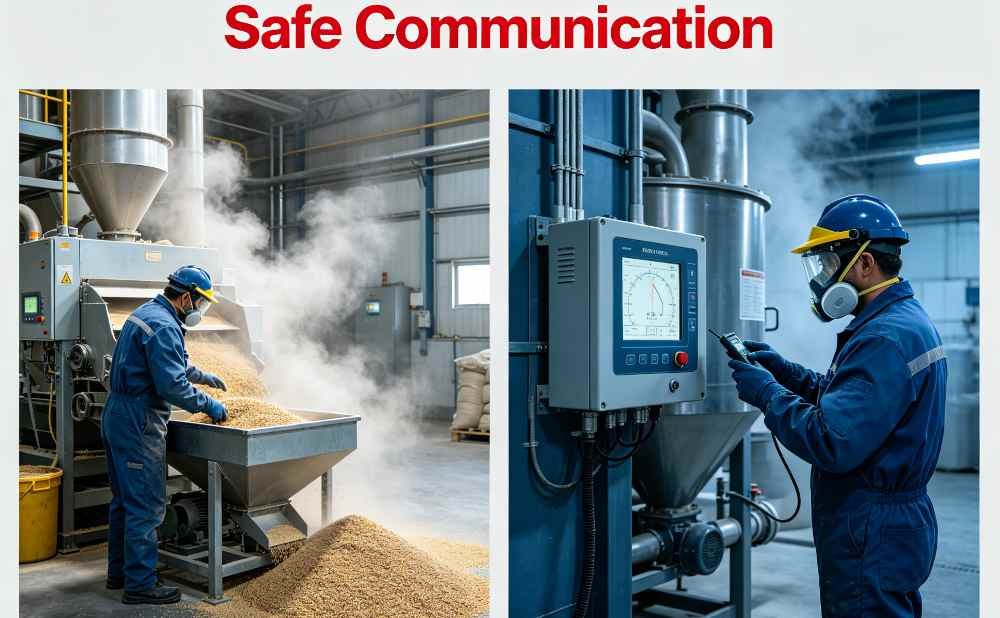
Looking for a reliable communication solution for food processing dust scenarios? Discover how RETEVIS MateTalk E2 solves on-site communication pain points, keeps your team safe, and ensures smooth operations in dust-prone food production environments.
Walk into any flour mill, feed processing plant, or grain processing workshop, and you’ll notice a common sight—fine dust floating in the air, clinging to equipment surfaces, piling up in corners of production lines, and even settling on control panels. To many plant managers and on-site workers, this dust seems harmless, a mere byproduct of daily operations. But the truth is far more alarming: combustible dust generated in food processing is a hidden time bomb. When these fine particles accumulate to a certain concentration, even a tiny spark can trigger a catastrophic explosion—destroying production equipment, halting operations for weeks or even months, and putting the lives of on-site personnel at severe risk. This risk is not limited to large-scale factories; small and medium-sized workshops are equally vulnerable, especially those that overlook dust control and lack a reliable communication solution.
In this blog, we’ll dive deep into the hidden risks of combustible dust in food processing scenarios, detail the specific pain points of communication in these environments, and introduce the RETEVIS MateTalk E2—equipped with IECEx and ATEX certifications, this explosion-proof radio is tailored to solve communication challenges in dust-prone food processing sites, providing a safe and reliable solution for every link of production.
The Overlooked Hidden Danger: Combustible Dust in Food Processing Scenarios
Food processing plants, regardless of size, generate a large amount of combustible dust during production—this includes flour from wheat grinding, feed powder from grain processing, corn starch from starch production, and even powdered sugar from confectionery processing. These dust particles are extremely fine, light, and easy to float in the air or accumulate on surfaces such as production lines, equipment gaps, and ceiling corners. The biggest problem lies in low awareness: most plant managers focus on food hygiene and product quality, but ignore the flammable and explosive properties of these dusts, mistakenly believing that “dust is just dust” and poses no threat.
Simply put, when combustible dust reaches a certain concentration (usually 10–50 g/m³, easily reached in closed workshops), it forms an explosive mixture with air. Even a tiny spark—from a standard walkie-talkie’s internal circuit or equipment friction—can ignite it, causing a chain explosion. For instance, in a flour mill grinding workshop, dust on conveyor belts and grinding machines can be ignited by a spark from a standard walkie-talkie, triggering a violent explosion. In recent years, many small fires and equipment damages in food plants have resulted from overlooked dust hazards and unsafe communication equipment.
Dust + Electrical Sparks = Disaster: Why Standard Walkie-Talkies Are Not Suitable
In food processing scenarios, communication is critical—whether it’s coordinating between the grinding workshop and the packaging workshop, arranging patrol inspections, or responding to emergency situations, reliable communication is the key to ensuring smooth operations and personnel safety. However, standard walkie-talkies are not designed for dust-prone and explosive environments, and using them in such scenarios is equivalent to placing a “time bomb” on-site.
Standard walkie-talkies have open internal circuits and unprotected antennas, which are prone to generating electrical sparks during operation. In a dust-rich environment, these sparks can easily ignite combustible dust, triggering accidents. In addition, standard walkie-talkies have low dust-proof levels, and dust can easily enter the device, causing short circuits, malfunctions, or even permanent damage—this not only affects communication efficiency but also increases the risk of spark generation. For this reason, food processing sites with combustible dust risks must use professional explosion-proof radios that meet international safety standards, among which IECEx and ATEX certifications are the core criteria for judging whether the equipment is suitable for dust explosive environments.
ATEX certification (compliant with EU standards) and IECEx certification (an international unified explosion-proof certification) are the most authoritative certifications for explosion-proof equipment in dust environments. They strictly regulate the design, production, and testing of equipment to ensure that the equipment will not generate sparks, high temperatures, or other ignition sources during operation, and can effectively prevent dust from entering the device. This is why the RETEVIS MateTalk E2, equipped with both IECEx and ATEX certifications, has become the first choice for food processing plants to solve communication safety problems.
RETEVIS MateTalk E2: Tailored for Every Dust-Prone Food Processing Scenario
The RETEVIS MateTalk E2 is not just a common communication device—it is carefully designed and optimized to be the ultimate reliable communication solution for the unique pain points of food processing dust scenarios. Whether it’s the closed grinding workshop with high dust concentration, the noisy packaging line, or the mobile patrol in the warehouse, the E2 can perfectly adapt, providing safe and clear communication support for every on-site worker. Below, we will combine specific food processing scenarios to detail how the E2 solves practical communication problems.
1. Explosion-Proof & Dust-Proof Design: Safe for High-Dust Workshops
The E2 is certified with both IECEx and ATEX (II 3GD/Ex ic IIC T4 Gc/Ex ic IIIC T100 Dc), meeting safety requirements for dust-prone food processing areas. Its screen version is IP68-rated, fully dust- and waterproof. In flour mill grinding workshops, where dust floats constantly and accumulates on equipment, the E2’s sealed design prevents short circuits and sparks. Its high-strength casing resists dust adhesion and is easy to clean—critical for maintaining hygiene. In feed plant mixing areas, where dust levels are extremely high, the E2 ensures stable communication between operators and material feeding staff.
2. High-Definition Noise Reduction: Clear Communication in Noisy Production Lines
Food processing workshops are noisy, with mixers, conveyors, grinders, and packaging machines running simultaneously. Packaging areas, for example, can reach 80–90 dB, causing miscommunication and delays. The E2’s advanced noise reduction filters ambient noise while preserving the speaker’s voice, ensuring clear communication. Workers can report low raw material levels to the warehouse clearly, avoiding production delays even in the loudest areas.
3. Lightweight & Portable: Perfect for On-Site Patrols
Patrol staff monitor dust, equipment, and production safety while carrying radios for extended periods. The E2 weighs just 200 grams, easily clipped or held without fatigue. It passes drop and vibration tests—if dropped from 1 meter or shaken, it continues working. In grain plants, patrol personnel can move freely between drying, grinding, and storage areas while maintaining smooth communication with the control center.
Beyond the Workshop: E2‘s Cross-Scenario Application in Food Processing Supply Chain
The RETEVIS MateTalk E2 provides safe communication across the entire food processing supply chain, going beyond production workshops, and tackles dust-related risks that workers often overlook. Below, we will detail its application in two key cross scenarios:
Dust Transport Fleets: Safe Communication on the Road
Trucks carrying grain, flour, or feed generate dust in cabs and cargo areas, which can float through gaps and create explosive risks. The E2’s explosion-proof, dust-proof design is ideal here: its sealed circuit prevents sparks, and IP68 protection keeps dust out, ensuring safe communication between driver and control center. With stable signal coverage, even on remote roads, drivers can report hazards—such as roadblocks or sudden dust surges—to the control center immediately, allowing timely follow-up and preventing accidents like dust explosions or material loss.
Warehousing & Storage Areas: Safe Communication for Dust-Prone Storage
Grain, flour, and feed warehouses generate dust during loading and unloading, which settles on goods and in corners. Staff need frequent communication to coordinate operations or respond to emergencies, such as local dust accumulation exceeding safety limits. The E2’s explosion-proof and dust-proof features ensure reliable operation even if dust settles on the device, while the sealed design prevents sparks. Its lightweight design allows staff to carry it easily when moving around the warehouse, ensuring smooth communication. For example, when dust concentration exceeds safety limits, staff can promptly call the cleaning team, reducing the risk of dust explosions.
Selection Guide: How to Choose the Right Explosion-Proof Radio for Food Processing Dust Scenarios
For food processing plants, choosing the right explosion-proof radio for dust scenarios is crucial—it not only relates to the safety of on-site personnel and equipment but also affects the efficiency of production operations. When selecting, focus on three key factors, which are exactly the core advantages of the RETEVIS MateTalk E2:
Compliant Certification
The most important criterion is whether the radio has authoritative explosion-proof certifications for dust environments. IECEx and ATEX certifications are the core standards—only equipment with these two certifications can ensure that it will not generate ignition sources in dust-prone environments. The RETEVIS MateTalk E2 is equipped with both IECEx and ATEX certifications, fully meeting the safety requirements of food processing dust scenarios.
Protection Level
Food processing dust scenarios have high requirements for dust-proof performance. It is recommended to choose equipment with an IP66 or higher protection level to effectively prevent dust from entering the device. The screen version of the E2 has an IP68 protection level, which is the highest level of dust-proof and waterproof performance, ensuring stable operation in harsh dust environments.
Scenario Adaptability
The radio meets the actual needs of food processing scenarios: it is lightweight and portable for patrols, reduces noise in busy workshops, and withstands harsh on-site conditions. The E2’s design fully considers these needs, making it more practical than generic explosion-proof radios.
Compared to top brands that often charge over $1,000 for similar explosion-proof radios, the RETEVIS MateTalk E2 offers the same level of certification, performance, and scenario adaptability at a much lower price (starting at $239.99 for the screenless version). This makes it a cost-effective solution for food processing plants of all sizes—whether it’s a small flour mill, a medium-sized feed processing plant, or a large-scale grain processing enterprise, the E2 can provide safe and reliable communication support without increasing too much cost pressure.
Final Recommendation: Choose E2 to Guard the Safety of Food Processing
Combustible dust is a hidden danger that no food processing plant can afford to ignore. It is not only a threat to the safety of on-site personnel and equipment but also may lead to production shutdowns and economic losses. Using non-compliant communication equipment will only increase this risk, while the RETEVIS MateTalk E2, with its IECEx and ATEX certifications, high dust-proof and explosion-proof performance, and scenario-tailored design, has become a reliable partner for food processing plants to solve communication safety problems.
Whether you’re managing a flour mill’s grinding workshop, a feed processing plant’s mixing line, a grain warehouse, or a transport fleet, the RETEVIS MateTalk E2 can adapt to your needs—its explosion-proof and dust-proof design ensures safety, its high-definition noise reduction ensures clear communication, and its lightweight and portable design ensures convenience. Don’t let overlooked dust risks compromise your plant’s safety and production efficiency—choose the RETEVIS MateTalk E2, and let it be your trusted reliable communication solution to guard every link of your food processing operations.
Views: 1